Total Sales:

KES 1.2M

Average Price:

KES 320/kg

Top Buyer:

ABC Exporters

Top Broker:

NCE Brokers Ltd

Highest Grade:

AA - KES 410/kg

Total Volume:

3,750 kg

Coffee regions

Kenya Coffee origin

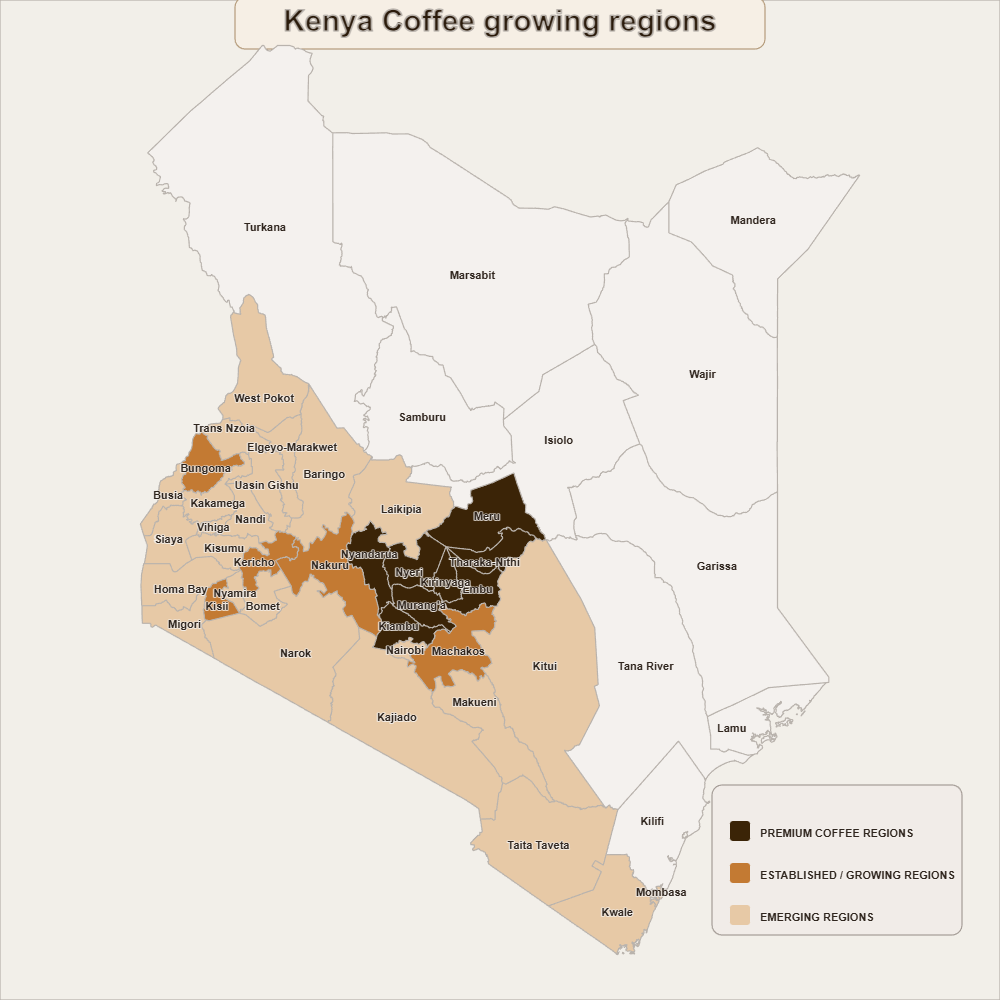
Explore coffee-growing counties and regions across Kenya. Select a county below the map to view regional details.

About Kenyan coffee

One of the world’s most sought-after origins

Kenyan coffee is recognised globally for its clarity, brightness, and complex flavour profiles. The combination of high altitude, volcanic soils, and distinct varieties creates a cup that is often described as wine-like, with vibrant acidity and fruity notes.

Coffee is grown mainly in the central highlands and the Rift Valley, including counties such as Nyeri, Kirinyaga, Murang’a, Kiambu, Embu, Meru, and parts of the western and Rift regions. Smallholder farmers deliver cherry or parchment through cooperatives to licensed mills, where coffee is processed and graded before being sold at the Nairobi Coffee Exchange.

Grading is based on screen size (e.g. AA, AB, PB, C), defect count, and quality. See our guide to Kenya coffee grades for a simple explanation of each grade. The auction system at the NCE ensures transparent price discovery and links producers with licensed buyers for export and local consumption. Use the county selector below to explore varieties, altitude ranges, and flavour profiles by county.

Arabica focus

Kenya grows almost exclusively high-quality Arabica (Coffea arabica), suited to high-altitude regions.

Altitude & climate

Coffee is grown at roughly 1,400–2,100 m in volcanic soils, with distinct wet and dry seasons.

Distinct varieties

Notable varieties include SL-28, SL-34, Ruiru 11, and Batian, each with distinct cup profiles.

Bright, complex cup

Kenyan coffees are known for bright acidity, full body, and fruity or wine-like flavours.

Coffee regions

Explore counties and regions on the map

Use the county buttons below the map to view varieties, altitude, and flavour profiles for each coffee-growing county.

Kenya coffee growing regions map: premium, established or growing, and emerging counties

Hover over a county on the map to see varieties, altitude, and flavour notes. On touch devices, tap a county. The legend shows premium, established or growing, and emerging regions.

Overview

Kenya Coffee origin

Hover a county on the map (or tap on a phone) to explore its varieties, altitude, and flavor profile.

Kenya is a top global producer of high-quality Arabica coffee.
Coffee trading is coordinated through the Nairobi Coffee Exchange auction system.
Renowned for bright acidity, clarity, and complex flavor profiles.

Value chain

Coffee from farm to Nairobi Coffee Exchange to buyers

Kenyan coffee moves from growers through cooperatives to mills for processing and grading, then to the NCE auction where licensed brokers facilitate sales to buyers.

Step 1

Farm

Growing & harvesting

Farmers and estates grow coffee across Kenya’s highlands. Ripe cherries are harvested and delivered to cooperatives or estate collection points as cherry or parchment.

Step 2

Cooperative

Aggregation & delivery

Cooperatives aggregate smallholder production from members, manage collection and delivery to mills, and ensure traceability. Parchment is delivered to licensed mills for processing.

Step 3

Mill

Processing & grading

Mills hull and clean parchment into green coffee. Grading is done by screen size (e.g. AA, AB, PB, C), defect count, and quality. Only coffee meeting the prescribed grade and quality standards is prepared for NCE sale.

Step 4

Nairobi Coffee Exchange

Auction & price discovery

Licensed brokers conduct weekly auctions at the NCE. Graded lots are sold through transparent, competitive bidding. Prices are discovered in the open market under CMA oversight.

Step 5

Buyers

Settlement & export

AFA-licensed buyers participate in bidding, settle trades within prescribed timelines, and take delivery. Coffee then moves to export, roasting, or local consumption.

How grading is done

At the mill, green coffee is graded by screen size (e.g. AA for large beans, AB, PB for peaberry, C), defect count, and quality according to prescribed standards. Only lots that meet the required grade and quality are accepted for sale at the NCE. This ensures buyers receive consistent, traceable lots aligned with Kenya’s reputation for high-quality Arabica.

Nairobi Coffee Exchange

Kenya is a top global producer of high-quality Arabica. Trading is coordinated through the NCE auction system—renowned for bright acidity, clarity, and complex flavor profiles.

From Crop to Cup

Quality at every stage